Every contact center plans for higher volume between Black Friday and the new year. Fewer plan for what that volume does to quality oversight, and peak season is when a QA program shows how well it was built.
Volume grows faster than the sample
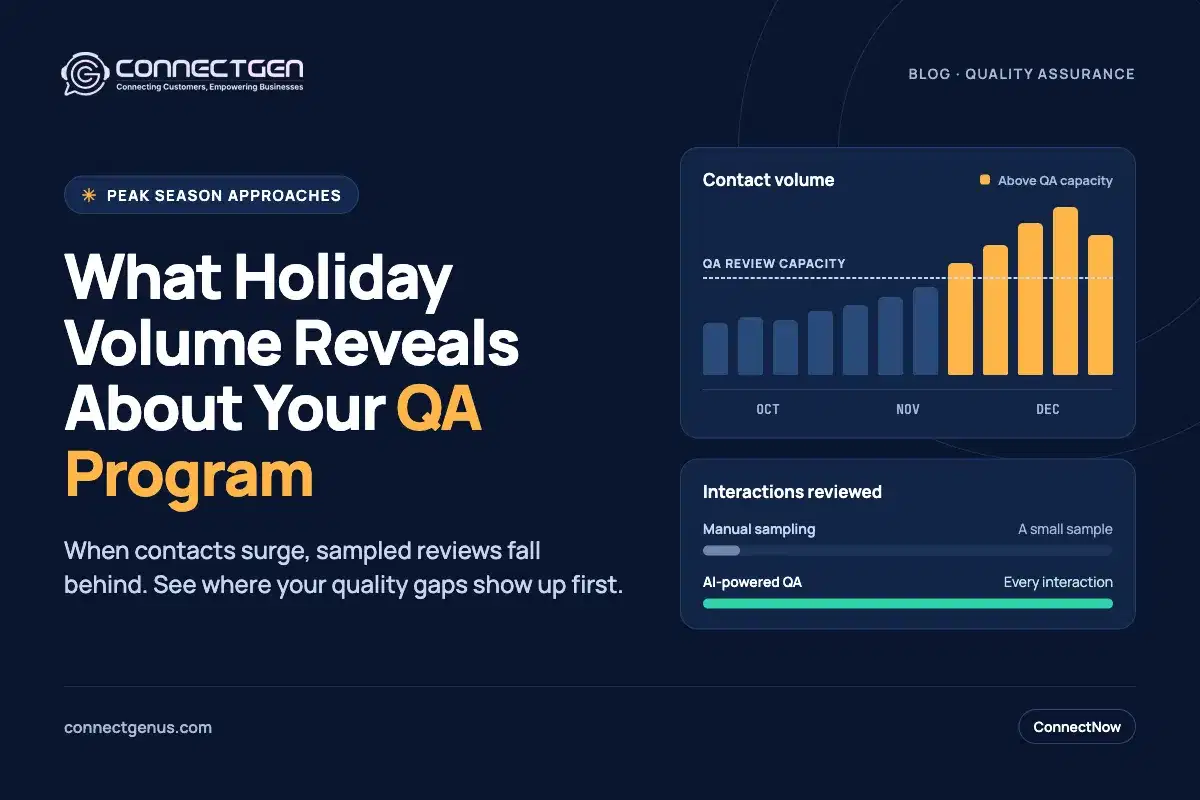
Often QA programs review up to 5% of interactions throughout the year and keeps the same review capacity during peak season. But volumes do not stay flat. Consider a standard customer service example: A 100-agent team averages 50 interactions in a typical day, or 150,000 interactions per month. 5% of interactions (7,500) are sampled. If November and December bring double the interactions to 100 per day, or 300,000 across the entire team for the month, but QA capacity stays the same, the reviewed share falls to 2.5% and 292,500 interactions go unseen. The program still produces scores, but the scores describe a smaller slice of what customers experienced.
New agents and new contact drivers arrive together
Peak season brings seasonal hires and a different mix of inquiries: order status, returns, billing questions, and promotion terms. New agents are still learning offer details and required disclosures, and those are the errors a small sample finds late. By the time a quality analyst reviews the omnichannel interaction, the same mistake may have repeated across dozens of other interactions.
Coaching speed matters more than report quality
Any weekly QA report arriving during the peak window documents problems instead of correcting them. If a behavior is identified on Monday, teams need to be able to act and coach on that same Monday… not wait a week to adjust. That requires scoring data broad enough to show which behaviors repeat across agents, not only which ones happened to appear in a handful of randomly reviewed interactions.
Questions to ask about your own peak results
Use your November and December data to test the program:
- Did quality scores hold as volume rose, or do you only have scores for the interactions sampled?
- How many days passed between an error first appearing and an agent being coached on it?
- Which contact drivers grew during peak that your scorecard did not anticipate?
- How quickly did new-hire scores approach those of tenured agents?
- Were compliance exceptions found through QA review, or through customer complaints?
If several of these are hard to answer, the gap is in coverage, not in effort.
ConnectGen assures full coverage, and immediate actions can be taken
ConnectNow scores 100% of interactions, compared with the 2–5% industry standard. In peak season, that means every new agent’s (including AI agents) interactions are visible from the first day, emerging contact drivers show up as they grow, and coaching reflects current behavior instead of last month’s sample. ConnectNow delivers 20+ point lifts in quality scores and roughly 80% reduction in QA effort, which enables analysts to spend their time on calibration of ai and coaching human agents rather than selecting calls to review.
Plan the next peak with better visibility
Peak volume does not create quality problems so much as expose the ones a sampled program cannot see.
Before your next busy season, run a QA audit of your current program. Measure how much of your peak volume was actually reviewed. ConnectGen can help you complete the review with a complementary assessment and show what 100% coverage would have found.
Contact Us to get started!